

Customer service is a crucial component of every e-commerce company. In fact, 77% of customers believe that providing excellent customer service is essential to creating customer loyalty and driving sales.
This manual includes methods to evaluate and enhance your present strategy as well as information on how to deliver first-rate customer support for your e-commerce firm.
Table of Content
- What is customer service for e-commerce sites?
- The Importance of Customer Service in E-Commerce
- Benefits of excellent customer service in e-commerce
- Key strategies for e-commerce customer service
- Avoid these e-commerce customer service pitfalls
- Conclusion
What is customer service for e-commerce sites?
The help and support given to online shoppers before, during, and after their purchase is referred to as ecommerce customer service. In order to increase client pleasure and loyalty in the online market, it also entails answering questions, resolving problems, and assuring a great online buying experience.
The Importance of Customer Service in E-Commerce
Customer service is no longer just a support job in the conventional sense. It has evolved into a crucial component of brand identification and client loyalty. Numerous studies show that after receiving subpar customer service, the vast majority of consumers are likely to transfer brands. On the other hand, providing excellent service can enhance client retention, encourage loyalty, and promote a business well.

Benefits of excellent customer service in e-commerce
Online shoppers aren’t the only ones who benefit from outstanding e-commerce customer service; businesses also benefit from it. The best customer care teams can contribute to increasing consumer trust in your e-commerce brand. Also possible are the following:
> Increase in patron loyalty
Online shoppers’ sense of customer loyalty grows when they are made to feel valued. In fact, a Statista poll revealed that 94% of consumers are more inclined to make a second purchase from a firm when they receive excellent customer service.
> Enhance user experiences
Online consumers who have technological difficulties can get help from ecommerce customer care, which can enhance their whole shopping experience. Online shoppers can also get immediate advice through self-service tools like chat rooms and FAQ sections.
> Eencourage more clients
Good news travels quickly. The more frequently your consumers enjoy their interactions with you, the more likely they are to tell others about it and send more people to your online store, which will benefit you in the long run.
> Increases in conversion rates
An essential indicator, the e-commerce conversion rate can be challenging to raise. The most crucial conversion measure you have: sales, can be moved with the aid of good customer service.
7 Effective practises for customer service in e-commerce
- 1. Use customer reviews
- 2. Social media engagement
- 3. Establish multichannel support
- 4. Include a FAQ page
- 5. Make use of live chat
- 6. Integration of CRM and personalization
- 7. Customize your strategy
1. Use customer reviews
A wonderful way to sort through client input is through customer reviews. Additionally, by being proactive with your customer service, you may better learn what your consumers want from your e-commerce firm when you interact with them and answer to those who have written reviews.
Providing for a customer’s requirements before they come to you or your customer service staff is known as proactive customer service. It’s a great method to boost consumer confidence in your e-commerce company and keep returning clients. You can make your online customers feel heard and valued by responding to reviews, both positive and negative.
2. Social media engagement
Customers frequently use social media to get quick answers. Customer service dedication can be demonstrated through following and interacting with clients on social media sites like Twitter, Facebook, and Instagram.


For instance, Zappos is well known for its outstanding social media participation. Their Twitter account rapidly answers client questions, turning potential issues into beneficial encounters.

3. Establish multichannel support
Modern consumers are by nature multichannel. That doesn’t simply apply to their shopping experience; after placing an order, buyers continue to communicate with brands through a variety of platforms.
Create multichannel customer assistance and go where the customers are. Give your e-commerce customer care team a direct channel of communication for anything from email and SMS to social media support in order to not only fulfil expectations but also give first-rate post-purchase service.
4. Include a FAQ page
The most prosperous e-commerce companies provide a self-help option for customers to use before escalating to a customer support representative.
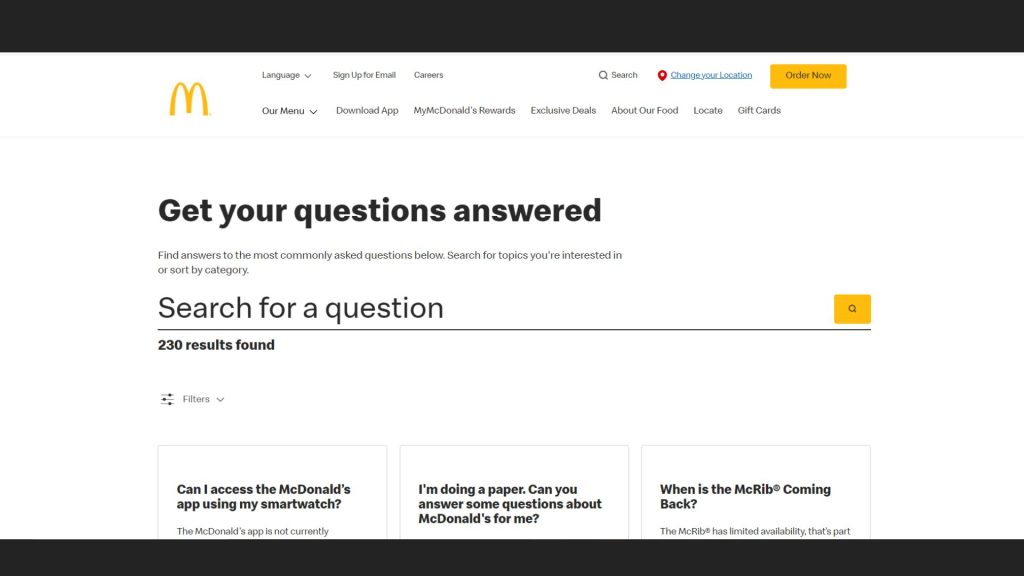
By creating some kind of resource—a frequently asked questions (FAQ) website or a thorough knowledge base—that addresses both the fundamentals and the most frequent issues, it will be simple to lower the quantity of support questions. Although the McDonald’s FAQ page is straightforward, we appreciate it since it has filters, a wonderful addition that improves the user experience.
There are more than 200 help centre articles available from the fast food chain, and readers may utilise filters to focus their search instead of continuously hitting the “Load more” button.
5. Make use of live chat
Some clients will go straight to your online store when they need help, speaking of omnichannel support. In 2022, 88% of web users will chat with chatbots, and 7 out of 10 will find the encounter to be positive, according to a Tidio survey.
Instead of making website visitors wait for your e-commerce customer care team to reopen, chat software provides immediate solutions to their questions.
Example: Shopify uses a reliable, round-the-clock live chat support system. The ability to provide customers with prompt support increases customer satisfaction and boosts conversion rates.

6. Integration of CRM and personalization
Customers remember personalised experiences for a long time. Agents can access client history and preferences by integrating your customer relationship management (CRM) system with your support platforms, which results in more individualised interactions.
As an example, Sephora uses its CRM information to customise encounters. A customer’s sense of value is increased when a support representative asks about previous purchases and preferences.

7. Customise your strategy
The concept of personalisation can be approached in various ways by every e-commerce company. When something goes wrong or when online buyers have problems, it could entail offering email or phone support from a customer service person.
Personalised customer service lingo and post-purchase follow-ups are further examples of how personalization can be used. Small gestures can go a long way, such as placing stickers or notes in your packing or sending personalised emails.
Key strategies for e-commerce customer service
1. Accessibility to multiple channels
Customers anticipate being able to contact businesses via a variety of channels, including social media, live chat, email, and more. Multiple options must be provided in order to accommodate various preferences and guarantee quick responses.
2. Quick and Responsive Support
In the digital era, speed is crucial. Respond as soon as possible to customer questions and issues. Automated responses can buy time, but thoughtful, genuine comments leave an impact that lasts.
3. Product Understanding
Customer support agents need to be very knowledgeable about your products. They may then give precise information, respond to inquiries, and make enlightening suggestions as a result.
4. Compassion and individualization
Customers desire to feel appreciated. Teach your employees to approach every interaction with empathy and to tailor replies to the needs of each individual consumer.
Avoid these e-commerce customer service pitfalls
1. Slowness of response
Online buyers anticipate brands to live up to or above their expectations. These requirements are more stringent when a customer service ticket is pending. According to a Tidio survey, waiting too long for responses is what most annoys respondents, or around 53% of those polled.
A simple technique to enhance customer service is to clearly define the expectations of your customers about response times. then confront or defeat them. Be transparent if your phone support is only available during a certain time period. Be upfront if response times are longer on the weekends.
2. Inconsistent messaging
One method to undermine your efforts to establish a solid brand reputation is through inconsistent messaging.
Use templates to guarantee that everyone who interacts with your brand has the same experience. Your most frequent customer questions should be written out and saved as a template. It guarantees that clients receive the same message regardless of which team member they work with, saves your agents time, and enables them to process more tickets quickly.
3. Programme without multichannel support
Making your personnel accessible to consumers is the first step in improving your support approach. However, it might be simple to lose track of who said what when handling multiple sources of communication. If you rely on personalisation to engage those calling support, that will throw a wrench in the works.
All incoming tickets are forwarded to one single location through help desk software. The same dashboard receives all incoming requests, including phone calls, emails, and direct messages from social media.
Customer relationship management tools like Gorgias or Reamaze, which provide multichannel assistance, can sync your Shopify data as well. A customer profile will be linked to each received ticket. Support staff can observe:
- The name of the client
- Customer preferences for contact
- The products that the customer ordered
- Any old trouble tickets
- The employee who handled their prior inquiry

Conclusion
Customer service for online retailers is not simply necessary; it also gives them a competitive edge. These seven suggestions can help businesses develop a customer-focused support system that will increase brand loyalty, increase sales, and set them apart in a crowded digital market. To deliver unrivalled online customer care, leverage the power of live chat, personalization, self-service, social media involvement, multichannel support, and proactive assistance. Keep in mind that in the digital age, providing excellent customer service might be the key to success.
Join us as you begin your Shopify journey
We are e-commerce specialists and Shopify Partners. Get in touch with us if you need assistance with Shopify, need a whole website built, or have any other general questions.